


The Eyes Of The Skin - Architecture And The Senses
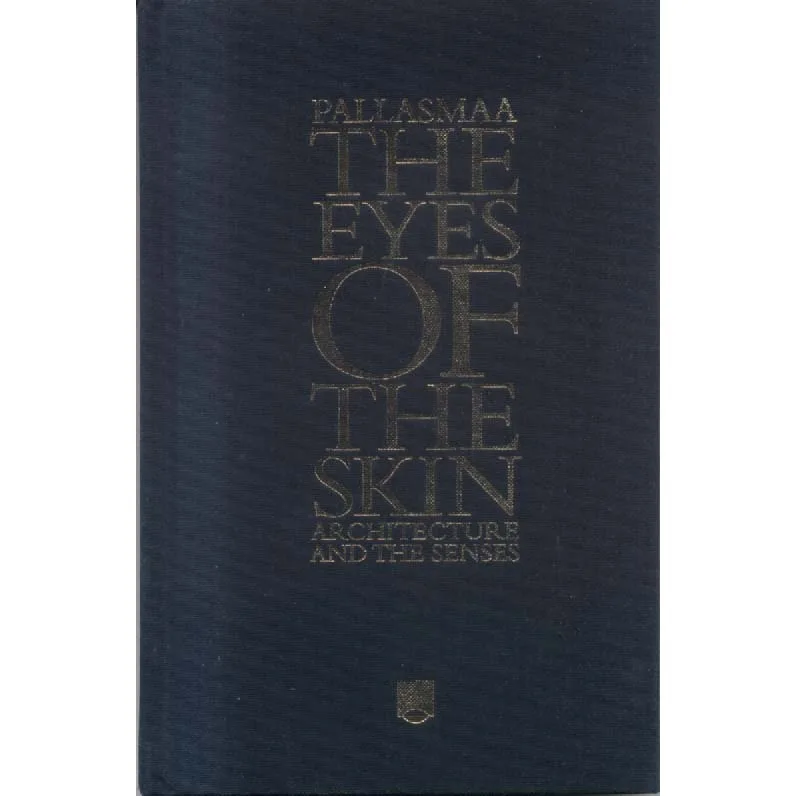
Publisher: Wiley
Format: Hardback
ISBN: 9781119941286
The Eyes of the Skin – Architecture and the Senses (2012) by Juhani Pallasmaa
Wiley
ISBN: 9781119941286
Condition: Good
Architecture books have a habit of showing you immaculate buildings photographed at dawn, with no bins, delivery vans, damp patches or people wondering where the toilets are. Juhani Pallasmaa’s The Eyes of the Skin takes a rather different approach and asks a more interesting question: what does architecture actually feel like?
This influential book argues that modern architecture has become far too obsessed with the eye. Buildings are designed to be photographed, rendered, admired from across a plaza and submitted to awards, while the rest of the human body is apparently expected to remain quietly grateful.
Pallasmaa is having none of it.
For him, architecture is something we experience through touch, sound, smell, movement, memory, temperature and bodily awareness as much as sight. A room is not simply a collection of dimensions and surfaces. It has acoustics. Texture. Weight. Warmth. Atmosphere. It can make you feel sheltered, exposed, calm, uneasy, welcome or vaguely as though you have accidentally entered a private dentist’s waiting room.
The title, The Eyes of the Skin, captures this central idea beautifully. We do not merely look at buildings. We inhabit them with our entire bodies.
A wooden handrail feels different from a polished steel one. A stone floor carries a different sense of age and permanence from vinyl. A narrow corridor affects us differently from a broad hall. Even the sound of footsteps can alter our perception of a space.
None of this is particularly surprising once somebody points it out, which is one reason the book is so effective.
Pallasmaa explores how Western culture has gradually privileged vision above the other senses, particularly in architecture and design. Modern technology, photography and computer visualisation have intensified this tendency, producing buildings that may look astonishing on a screen while being considerably less interesting when you actually have to stand inside them.
The architectural equivalent of food designed exclusively for Instagram.
His argument is not that buildings should stop being beautiful. Quite the opposite. He wants architecture to become richer by engaging more deeply with the full range of human experience.
Materials should feel like materials.
Spaces should have atmosphere.
Buildings should acknowledge that their occupants possess hands, ears, feet and memories rather than merely functioning as mobile pairs of eyes.
Pallasmaa draws on architecture, philosophy, art, literature and psychology, making this a surprisingly wide-ranging little book. He discusses everything from shadows and silence to memory, intimacy and bodily perception, showing how buildings can become deeply embedded in our sense of place and identity.
Anyone who has returned to a childhood house after many years will understand what he means. You may forget exact dimensions, but remember the sound of stairs, the texture of a wall, the smell of a room or the peculiar patch of cold beside a particular window.
Architecture lives in memory through sensation.
That is the territory Pallasmaa is exploring.
The book has become something of a modern classic in architectural education, partly because it offers such a useful counterweight to purely visual design thinking. It reminds architects and designers that human beings actually have to occupy the spaces appearing so elegantly on their monitors.
There is also an appealing irony in a book criticising visual dominance becoming such an attractive and widely admired object in its own right.
Still, Pallasmaa would probably forgive us for looking at it.
Just remember to touch the cover occasionally.
For architecture students, designers, artists, photographers, philosophers and anyone interested in why some buildings feel wonderful while others feel like expensive railway stations, The Eyes of the Skin offers a compact but remarkably thought-provoking exploration of how we experience the built world.
It may also permanently alter the way you walk into rooms.
After reading it, you may find yourself noticing door handles, floor textures, echoes, shadows, smells and changes in temperature with considerably more seriousness than before.
Which is either a major expansion of architectural awareness or the beginning of becoming extremely difficult to take shopping for kitchens.
This 2012 Wiley edition is in Good condition, meaning it has been physically handled and experienced as an object, which seems entirely appropriate for a book arguing that physical experience matters.
Available from Crappy Old Books, where books are still permitted to possess texture, weight and the occasional slightly dog-eared corner.
Keep browsing: See more Architecture books Other books by Juhani Pallasmaa
